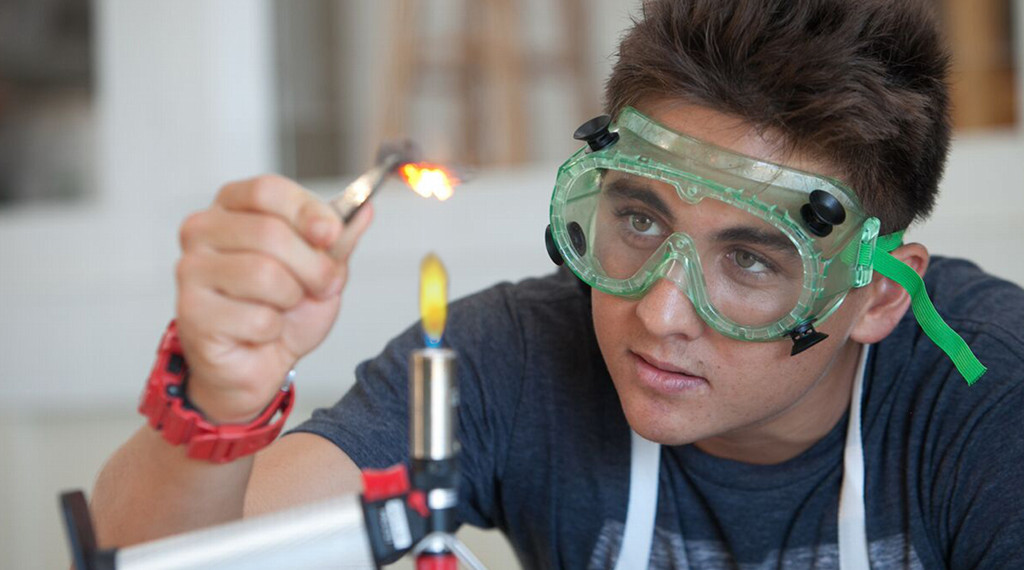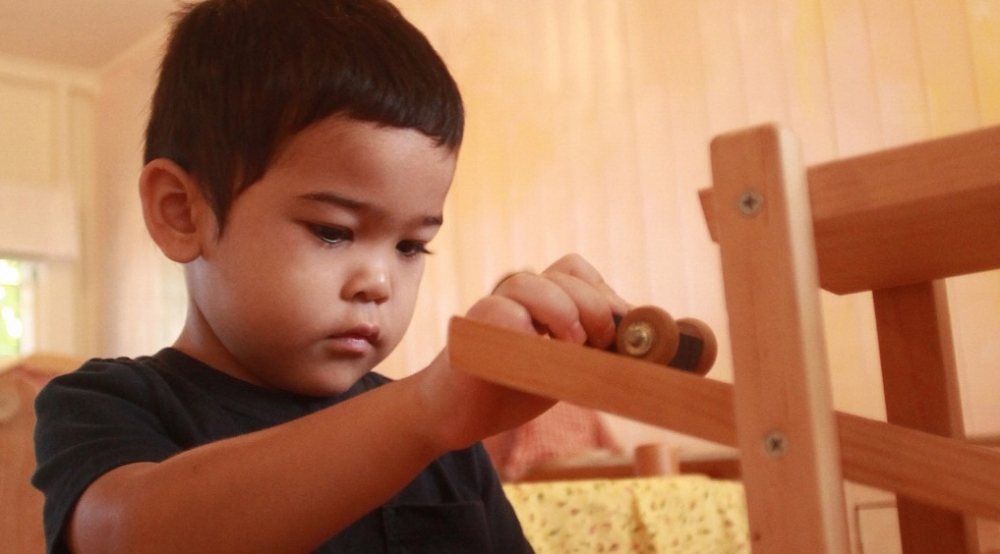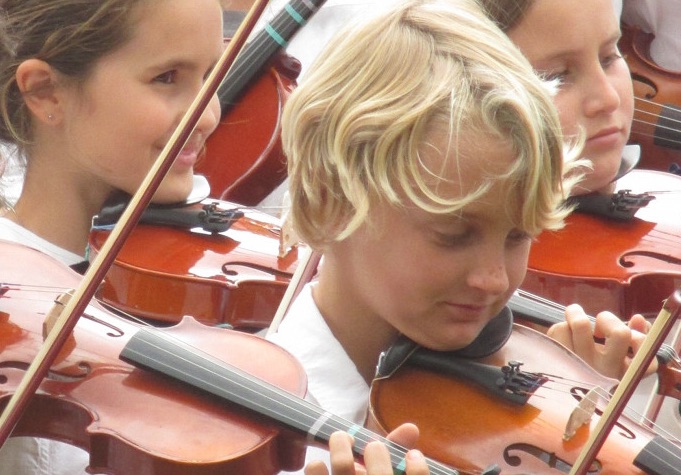
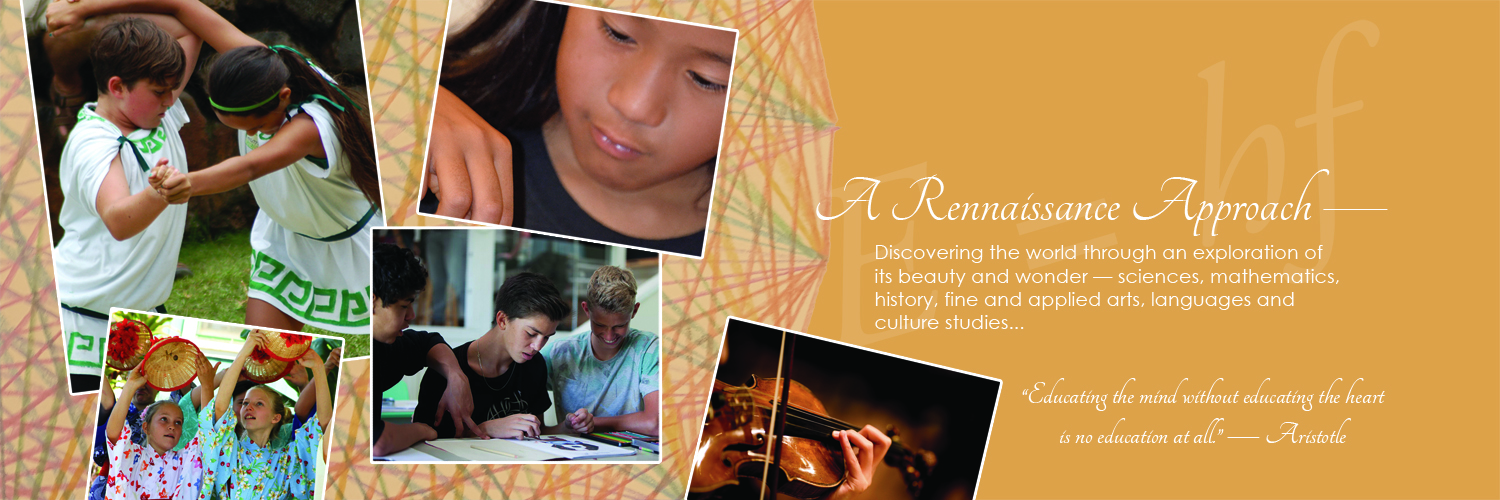
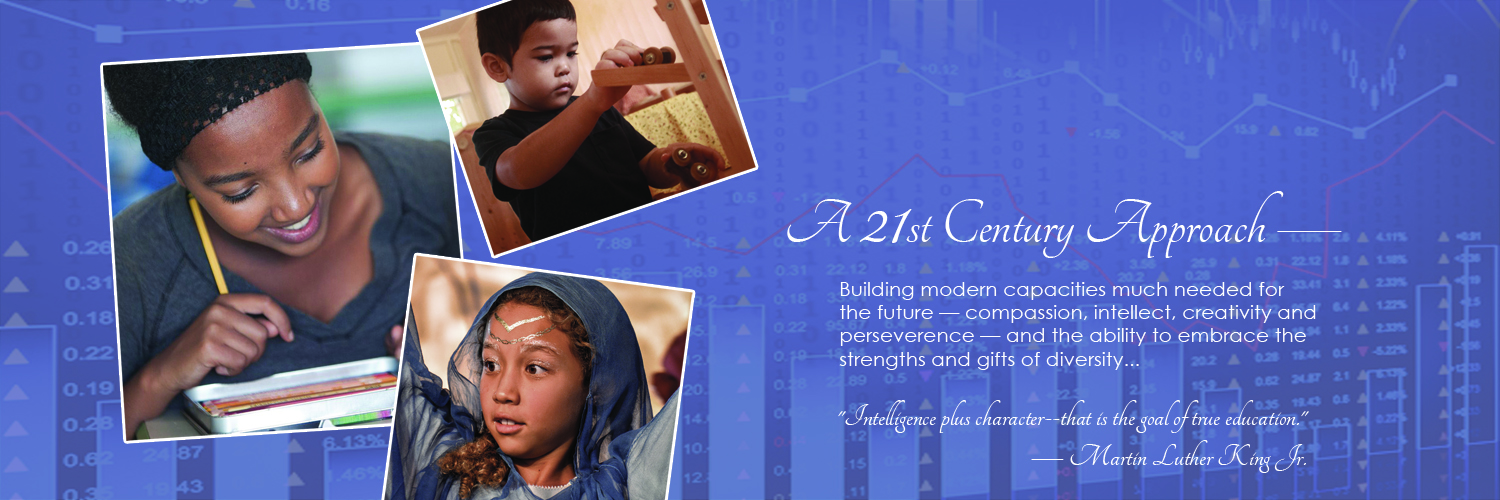
HWS students are engaged children with an active curiosity for the world around them.
In the Classroom
Waldorf education provides a rich experience that aims to prepare children to meet the challenges of our world and the future with clarity of thought, a caring heart and confidence.
HWS achieves this aim with a creative experiential approach that addresses the whole child: mind, body and spirit.
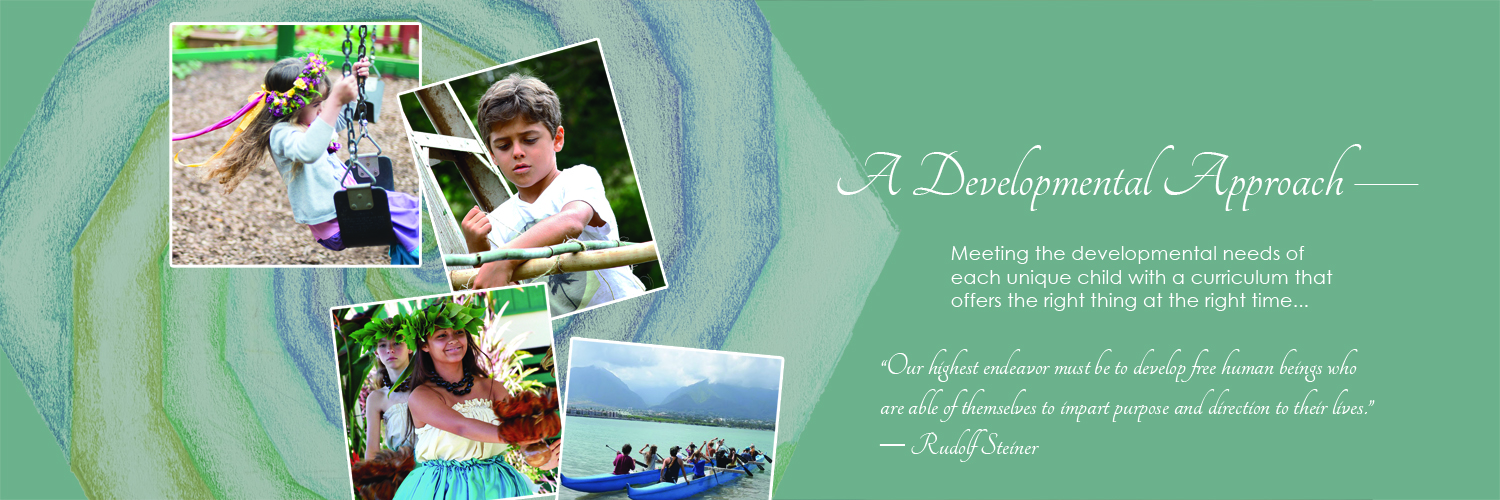
The Waldorf curriculum recognizes that children have distinct, age-related educational, emotional and neurological needs according to their naturally unfolding stages of development. To meet these needs, the arts are integrated into virtually every element of the curriculum. Children experience the lesson's content through drawing, painting, song, recitation, drama and movement.
Early Childhood Program
Many parents visiting Haleakalā Waldorf School's Early Childhood classes feel an instant, intuitive connection.
—often saying, "I wish I had gone to a school like this."
The room is warm, colorful, cared-for and filled with nature's beauty and variety—a place where children can let their imaginations roam while feeling reassured and protected.
The young child learns primarily through imagination, action and imitation, by seeing and doing. The goal of the Waldorf Early Childhood program is to develop a sense of wonder in the young child and reverence for all living things.

Participating in household tasks builds a sense of community as well as individual responsibility.
Our Waldorf Early Childhood programs provide a nurturing environment based on an understanding of the young child’s special developmental needs before the age of seven. We have 2 mixed-age preschools: the ‘Apapane Preschool and the I’iwi Preschool serving children between the ages of 2 to 4 years. We also have two mixed-age kindergartens: the Nene Kindergarten and the Pueo Kindergarten serving children between the ages of 4 to 6 years.
The mixed-age classrooms have the advantage of being like a large family; the older children benefit from providing a model for the younger ones and helping them along, while the little ones benefit from having role models at the next developmental stage to emulate. Another added benefit is the softness the younger ones bring to the older ones. As the children stay in one class for one or two years, those who were younger get to experience being the ‘bigger’ children at some point.
The program is structured to provide age-appropriate activities for all children. As the class progresses in age and ability, teachers shift the activities to meet the changing needs of the group. The curriculum is designed so that children can learn from each other and each can develop at his or her own pace in a non-competitive setting. The mornings typically consist of creative play, an artistic activity, a story, singing, games and finger plays, snack, outside play and lunch.
An emphasis on practical life skills, such as children once experienced in a home environment, allows the child’s cognitive skills to unfold naturally. Along with vigorous, healthy play, these are the kinds of experiences that provide the nerve activity needed for higher learning in the areas of language development, dexterity, math skills, social skills, and creative thinking.
The Early Childhood Department is looking for children and their families that are a good fit with our school and its philosophy of play based/nature oriented curriculum. Specifically, we are looking for families that want to enroll their children in our school all the way through eighth grade in a long term relationship with the school and with the “co-parents” in your child’s class.
To facilitate this we are looking for those who share our values and are interested in:
- Preserving a play-filled childhood for their child, in which "formal" academic instruction begins in first grade.
- Learning about child development and the stages of childhood within the Waldorf tradition.
- Helping to create a peace filled, kind, tolerant, media free, community environment allowing each child to safely unfold at his/her own pace.
- Creating a healthy and nurturing, rhythmical life at home that allows the young child to develop to their full potential in mind, body, and spirit.
For more information, please follow this link to our admissions page.
Punana Parent+Child Program
Discover new ways to observe and understand your young child.
A beautiful, home-like infant/toddler center called the Punana Parent+Child Program for families with young children was opened August 19, 2009. The Punana Parent+Child Program, facilitated by Kim Raymond, provides children with a safe and nurturing nursery environment while offering parents the opportunity to be inspired, supported, and transformed in their day to day interactions with their young child.
Kim Raymond says, “Parenting is a journey, a path of transformation, for which we are rarely ever fully prepared.” The Punana Parent+Child Program will offer parents the opportunity for an in-depth exploration of current parenting topics such as motor development, care and protection of the senses, creating rhythm and routine, health and nutrition, and sleep. Parents will develop skills of observation to deepen their intuitive knowledge and identify what is needed for their child.
Classes are offered Thursdays and Fridays in three 10 week sessions.
All classes are held in a new classroom designed to replicate the warm atmosphere of a home at the school’s Kula campus. Call 878-2511 for more information.
'Apapane and I'iwi Preschool
The 'Apapane and I'iwi preschools serve ages 21/2 to 4. Two, three, and five day programs are offered from 8:30am to 2:30pm. Children who will be 21/2 years old by June 1st of the year they will enter the program, through “young” four year olds are elagible. All children should be weaned and potty trained.
Children develop the capacity for creative thinking, problem-solving and social interaction through their free imaginative play.
The equipment provided at HWS is simple and made of beautiful, natural materials, so that a child’s imagination can be stimulated. For example, a length of silk fabric may become the king’s cape, a tent for travelers, or a tablecloth for tea.
Celebration and rhythm are also important aspects of the young child’s daily experience. Each day’s activities include creative play, morning circle (including socializing games and rhythmical activities developing coordination and balance), and storytelling time.

The yearly rhythm of festivals and holidays provides many important celebrations in the preschool enriching the early childhood experience and creating a bridge from home to school.
For more information, please follow this link to our admissions page.
Pueo and Nene Kindergarten

Pueo and Nene Kindergartens
There lives within Waldorf education the realization that timing is of the utmost importance in introducing academic tasks to children.
|
 |
In morning circle, the child learns to enjoy the sounds of language, to share through socializing games, and to achieve coordination and balance through a variety of rhythmical activities.
The Kindergarten experience provides a deep foundation as well as a readiness and an eagerness for the academics that follow in the grades.

Each child moving from kindergarten to first grade hand sews a baby doll and a blanket and participates in a beautiful ceremony marking the child's passage into their next developmental stage.
At Haleakalā Waldorf School, we offer two kindergartens. Each kindergarten serves up to 22 children per day on a five day per week program, 8:30am to 2:30pm. Applicants for the Nene and Pueo kindergartens should be “older” four year olds through five year olds. These children will move up to first grade when they are six by June 1st prior to going to first grade.
For more information, please follow this link to our admissions page.

Each day every student is greeted with an eye-to-eye handshake by their teacher.
Elementary School
In a Waldorf school, the class teacher ideally stays with the class for eight years—leading his or her class through each day's morning lesson from first through eighth grade.
|
This continuity enables a deep understanding of each student's strengths and challenges and supports the development of a rich social dynamic in the class. When a Waldorf teacher meets his or her first grade class it is the beginning of a remarkable eight year journey. The class teacher is responsible for the main lessons, and through them, introduces the entire panorama of the elementary school curriculum.
|
 |
The class teacher is also able to bring continuity to the curriculum,
unifying the various disciplines over the years and seeking the
best means to connect the curriculum to each unique child.

Our campus offers a garden like environment with grassy play areas.
The opportunity for children of different ages to play and interact in
peaceful and healthy ways is encouraged.
The Elementary School Curriculum includes:
English and Language Arts based on world literature, myths, and legends
History that is chronological and inclusive of the world's great civilizations
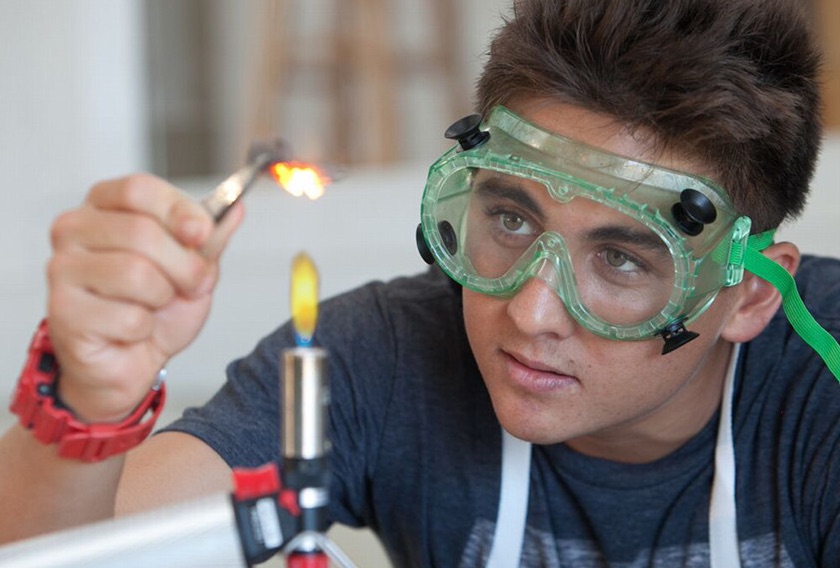
Science that surveys geography, astronomy, meteorology, physical and life sciences
Mathematics that develops competence in arithmetic, geometry, and algebra
Foreign Languages Grades 1-5 have Japanese and Spanish twice weekly, grades 6- 8 have Spanish
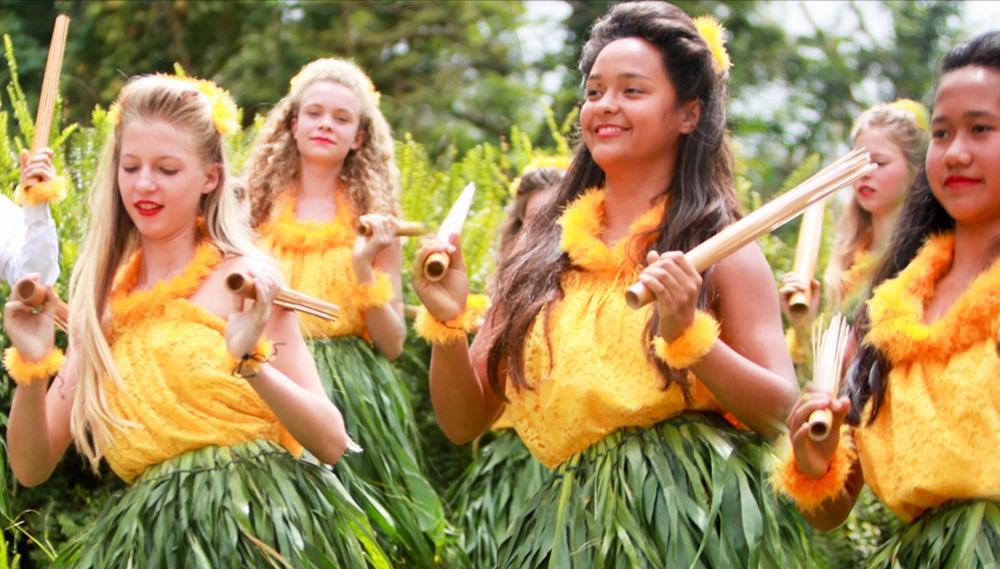
Hawaiiana including hula, chant, ethnobotany, culture, language and crafts
Physical Education three times weekly
Gardening Grades 1-5 spend several hours in the garden weekly
Music Choral singing meets twice weekly. Recorder is played in each grade twice weekly. Ukulele is practiced twice weekly in the middle school
Painting and Applied Art Using the wet on wet technique, each class enjoys painting twice weekly. Additionally the students are exposed to sculpture, pencil sketching, chalk and charcoal media
Drama Each class performs at least one play per year for the student body. Students recite poetry and play recorder at student assemblies
Crafts This class meets twice per week. Students engage in handwork such as knitting, weaving, ceramics, printing, basket making
Festival and Seasonal Celebrations
For more information, please follow this link to our admissions page.
Middle School
The Waldorf Middle School is a dynamic place filled with the energy of engaged and enthusiatic students.
The curriculum achieves an integrated balance between the sciences, the humanities, and the arts as it leads the child through the basic branches of knowledge through the main lesson system.

As part of their Language Arts curriculum, eighth graders write, illustrate and bind
a story book for a first grade student. The opportunity to consider a younger child
with this thoughtfulness is rarely provided to adolescent children.
The main lesson is a two hour period at the beginning of each day saturated in one subject area for three to four weeks at a time. This continuity allows for each subject to be approached with greater depth utilizing all modalities of learning. During main lesson the students create their own text books, expressing the subject matter in writing and illustration. This process allows for true understanding and retention of the lesson.

In addition to the class teacher, the Middle School Student is supported by our Middle School Math and Science Teacher, Language Arts Specialist, and specialists in subjects such as foreign language, physical education, music, painting, Hawaiiana, and handcrafts.
Grade Six
Transition from Grecian world to Roman
Ancient Rome: the Kings, the Republic, the Empire, the Middle Ages
Business math: Percentages, banking, currency and simple interest
Geometry
Language arts: Grammar (subjunctive mood and the conditional), spelling composition, literature
Physics: Introduction to light and color, heat, sound, magnetism, and electricity.
Astronomy: Geocentric and phenomenological including the influence of stars and planets on various aspects of Hawaiian life
Knitting in the round with four needles
Geography: Climactic zones and oceanography
Recorder and Ukulele music
Hawaiiana including stories, hula and crafts
Spanish Language
Movement education
Grade Seven
Middle Ages to the Renaissance: Joan of Arc to the Elizabethan Age
Age of Discovery and the Conquistadors
Astronomy: Copernicus, Galileo, Brahe, Kepler
The Reformation
Geography of Asia and Europe
Introduction to Algebra
Nutrition and Physiology
Chemistry
Mechanics
Peer mediation skills
Community service
Perspective drawing
Articles of clothing sewn by hand
Recorder and Ukulele music
Hawaiiana including stories, hula and crafts
Spanish Language
Movement education
Grade Eight
The Age of Revolution - French Revolution, American Revolution, Civil War and Industrial Revolution
American History
World Geography
Physics: Practical applications of electricity, steam engines, thermodynamics, hydraulics
Physiology: Eye, ear, larynx, skeleton
Organic chemistry
World History: Napoleon to WWI and WWII to the present time
Community Service
Algebra
Recorder and Ukulele music
Hawaiian stories, hula and crafts
Spanish Language
Movement Education
For more information, please follow this link to our
admissions page
.
Special Programs
After School Care
Our After School Care program is available HWS students, Preschool-8th Grade) Monday through Friday from 2:45 pm - 5:00 pm. Organized activities, free play time, and quiet time for doing homework are all part of the daily after school program. Information on After School Care fees is available in the HWS Business Office.